


Clashes over public housing projects and a Taipei Dome project marred Taipei Mayor Hau Lung-bin’s (郝龍斌) report to the Taipei City Council yesterday, with dozens of protesters blocking the entrance to the city council building to urge the mayor to improve communication with residents before drafting policies.
Shouting “Give the supermarket back to us, we don’t want public housing units,” a group of residents of Wenshan District (文山) criticized the city government over its plan to build 174 public housing units in their community despite opposition to what residents perceive as a rushed municipal project.
“The neighborhood is too small to accommodate so many housing units. Poor management of public housing units is also a major concern,” resident Wang Wei-lin (王微琳) said.
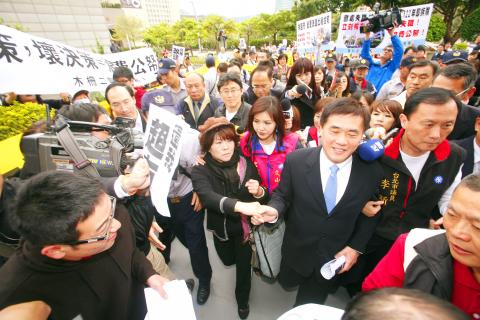
Photo: Liu Jung, Taipei Times
Taipei City councilors across party lines, including Chinese Nationalist Party (KMT) Councilor Lin Yi-hua (林奕華), KMT Councilor Lee Ching-yuan (李慶元) and Democratic Progressive Party (DPP) Councilor Hsu Chia-ching (徐佳青), supported the protesters, calling on the city to distribute public housing units throughout the city’s 12 districts proportionally.
Of all 1,500 public housing units in Taipei, Lee said, 1,020 are located in Wenshan District.
“We do not oppose public -housing, but it’s unfair to build all the units in one district. The city government needs a comprehensive plan and must communicate better with local residents,” he said.
At the heart of the controversy is a plan by the city to convert an abandoned supermarket on Wanli Street into a public rental apartment as the first phase of a project to increase the number of affordable housing units throughout the city to 50,000 in the next four years.
Each of the planned public housing units would be about 21 ping (69.4m2) and rent would be about NT$11,000 per month, or about 80 percent of average rent in the area.
Meanwhile, a small group of -environmental activists protested in another corner outside the Taipei City Council against the planned construction project of the Taipei Dome, a 40,000-seat complex that is to be built on the site of the Songshan Tobacco Factory in Taipei.
Leading the protest, Green Party Taiwan spokesman Pan Han-shen (潘翰聲) said the city should revoke the contract with Farglory Group and stop the project immediately.
Swamped by protesters and reporters, Hau slowly made his way into the city council building escorted by security guards without offering comments.
“I heard the protesters’ voices and we will examine the projects and see what we can do,” he said.

UPGRADE: The Kang Ding-class frigate is replacing its Chaparall missiles with Tien Chien II and Hua Yang VLS, which would provide it with long-range, 360° air defense Taiwan plans to produce 1,200 to 1,376 Hai Chien II missiles (海劍二, Sea Sword II) — also known as TC-2N — to serve as the standard air defense system of the navy’s surface combatant fleet, a source said yesterday. Last week, the Hai Chien II, the naval version of the Tien Kung II missile (天劍二, Sky Sword II), completed a live-fire test in waters off the National Chungshan Institute of Science and Technology’s Jiupeng facility (九鵬) in Pingtung County’s Manjhou Township (滿州). The MIM72 Chaparral and other dated air defense missiles that currently arm Taiwanese ships have inadequate range to combat Chinese

REASONS FOR TRAVEL: An assistant professor said that proposed amendments to penalize drivers if they used drugs overseas would not deter people from traveling People who operate a motor vehicle under the influence of marijuana would have their driver’s license revoked, even if they used the substance while overseas, the Ministry of Transportation and Communications said yesterday, citing proposed amendments to the Road Traffic Management and Penalty Act (道路交通管理處罰條例). The amendments would also authorize the government to revoke the licenses of people determined to have used Category 1 or Category 2 narcotics, even if they were not operating a vehicle while under the influence of drugs, as well as ban them from taking the license test for three years, the ministry said. People aged 18 or

HEAVY WEATHER: Typhoon Jangmi is due to crash straight into the Ryukyus as airlines look to shift flights to larger aircraft or cancel flights to Okinawa entirely Taiwan’s international air carriers announced flight adjustments over the weekend as Typhoon Jangmi is forecast to hit the Ryukyu Islands today and tomorrow. The Central Weather Administration (CWA) upgraded Jangmi from a tropical storm to a typhoon at 8am yesterday, with the eye located 580km south of Naha city. It was moving north at 19kph. Today, China Airlines’ CI-120, CI-121, CI-122 and CI-123 flights between Taoyuan and Naha, Okinawa, have been canceled as well as CI-132 and CI-133 between Kaohsiung and Naha. EVA Air’s BR-112, BR-113, BR-186 and BR-185 flights between Taoyuan and Naha are also canceled. Low-cost carrier Tigerair Taiwan canceled IT-230,
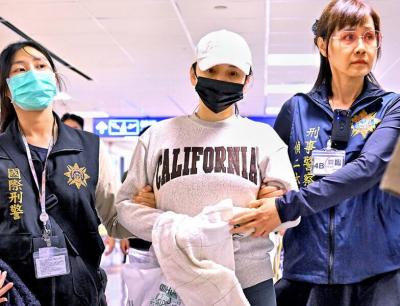
Johanne Liou (劉喬安), a Taiwanese woman who shot to unwanted fame during the Sunflower movement protests in 2014, returned to Taiwan last night after being deported from the US. She is to stand trial in Taiwan for charges involving embezzlement, fraud and drug crimes. The Criminal Investigation Bureau (CIB) said it took her into custody at Taiwan Taoyuan International Airport and would first question her before transferring her to the New Taipei District Prosecutors’ Office. She was arrested upon disembarking a flight from San Francisco that landed shortly before 7pm. Liou absconded to the US in 2019 after jumping bail


 RSS
RSS